
Over the past few years, “tokenization” has become one of the fastest-growing trends in global finance. From real estate and private credit to stocks, funds, and art, the world’s most valuable assets are moving on-chain. Financial institutions, regulators, and technology platforms are now accelerating this shift, with tokenization expected to reshape how assets are created, owned, traded, and governed.
But what does tokenization actually mean? How does it work in blockchain? Why are tokenization platforms gaining so much traction? And why do industry analysts believe tokenized assets could eventually reach into the trillions?
This guide breaks everything down in a simple, beginner-friendly way — while also giving you a clear view of what is happening in the industry as we enter 2026 and how platforms like Allo are poised to redefine asset ownership.
What Tokenization Really Means (Beginner-Friendly Definition)
Tokenization is the process of transforming any real-world asset, a property, a share of a company, a mortgage, a piece of art, a fund, a bond, or even revenue streams, into a digital token recorded on a blockchain.
These tokens represent legal, compliant, auditable ownership rights, backed by real underlying assets.
Institutions are adopting tokenization for several reasons:
Tokens can be transferred 24/7.
Ownership can be fractionalized.
Settlement is instant (vs. days in traditional finance).
Smart contracts enable programmable rules (fees, lockups, rights).
Global investors can be onboarded digitally.
Reporting and NAV can be automated on-chain.
This is why search demand for “tokenization platform,” “asset tokenization platform,” “real world asset tokenization platform,” and “rwa tokenization platform” is rapidly increasing. Investors, developers, fund managers, and enterprises now understand that tokenization is not just a blockchain trend, it is a new financial infrastructure layer.
Why Tokenization Is Taking Off: Real Adoption, Not Hype
Tokenization has moved past experimentation. In 2024–2025, several major real-world changes pushed it to the forefront:
1. Institutional momentum
Leading financial institutions, including asset managers, public companies, and global banks, launched tokenized funds and RWAs on public blockchains, signaling a shift from “pilot” to “production.”
2. Regulatory progression
Jurisdictions such as the UAE, Singapore, Switzerland, Luxembourg, and Hong Kong made significant progress in supporting digital securities, tokenized fund structures, and compliant secondary trading. Land registries (like Dubai’s) even began exploring tokenization pathways for real estate.
3. Explosive growth in on-chain RWAs
Independent research from industry analytics firms tracked a multi-fold increase in tokenized real-world assets between 2023 and mid-2025, reaching tens of billions of dollars on-chain. This includes tokenized U.S. Treasuries, private credit pools, money-market funds, corporate bonds, mortgages, art, and more.
4. Government, enterprise & fintech adoption
Governments now examine tokenization for public sector infrastructure (land titles, registries), while enterprises explore white label tokenization platform solutions for internal use cases such as financing, asset sales, and customer investment products.
The shift is undeniable: tokenization has moved beyond crypto markets into the mainstream financial system.
How Tokenization Works (Explained Simply)
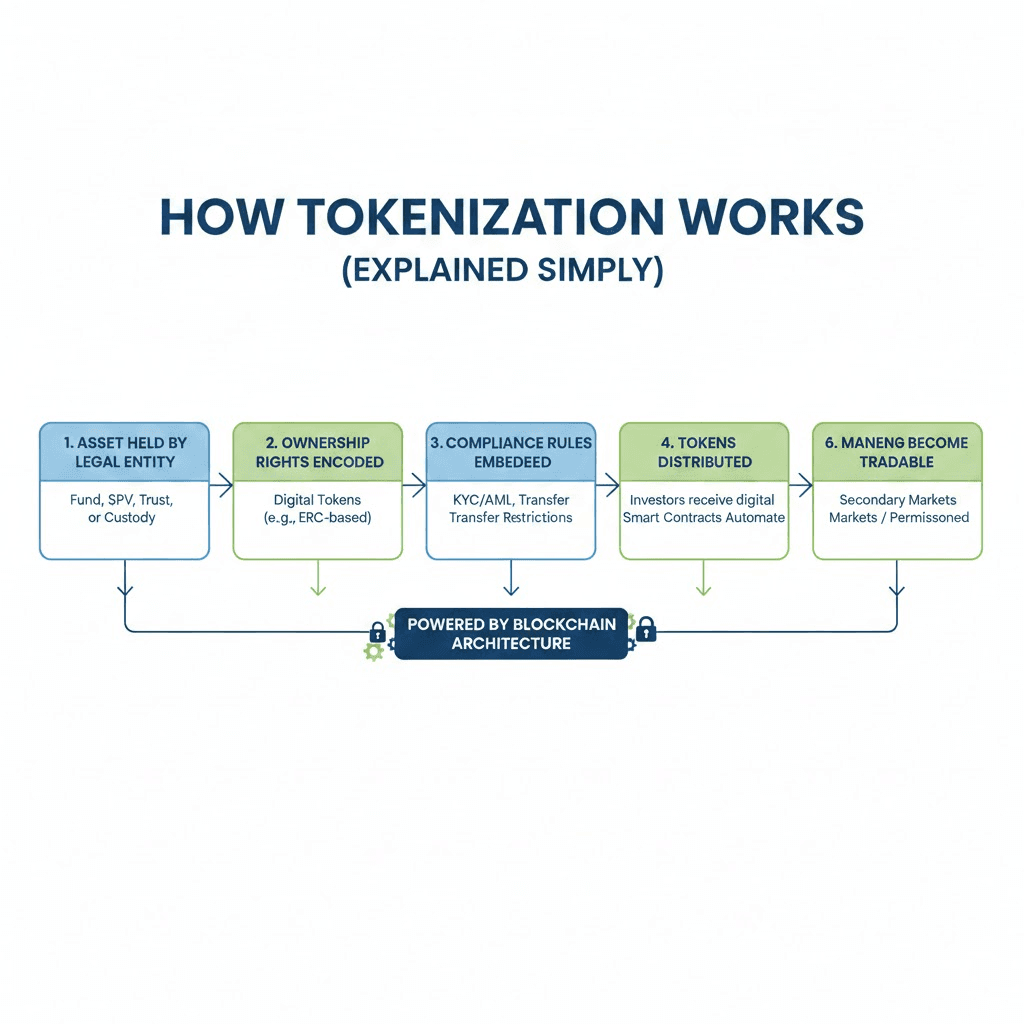
Tokenization works through a combination of legal structuring, compliance, custody, and blockchain architecture. Here is the simplest breakdown:
A legal entity or wrapper holds the underlying asset
This could be a fund, SPV, trust, or custody arrangement.Ownership rights are encoded into digital tokens
These might follow standards like ERC-based tokens or purpose-built security token formats.Compliance rules are embedded
KYC/AML, transfer restrictions, lockups, accredited-only access — all enforced on-chain.Tokens are distributed to investors
Investors get a digital token representing economic rights.Management, reporting & NAV move on-chain
Smart contracts automate calculations, payouts, and data transparency.Tokens become tradable
Depending on regulation, tokens can move on secondary markets or remain transferable within permissioned environments.
This creates a programmable ownership structure that is more flexible, efficient, transparent, and liquid compared to traditional financial rails.
Use Cases: Tokenization Is Reshaping Every Asset Class

Tokenization is not limited to a single industry. It is spreading everywhere. Here are the major categories where tokenization platforms are transforming markets:
Real Estate Tokenization
Platforms labeled as a real estate tokenization platform are helping developers, landlords, REITs, and investors fractionalize property ownership.
Benefits include global access, lower minimums, instant settlement, and increased liquidity.
This growing sector also includes:
best real estate tokenization platform
real estate tokenization platform development
binaryx real estate tokenization platform
tokenization platform for real estate assets
Equity, Funds & Public Markets
Tokenization brings 24/7 trading, fractional ownership, and faster settlement to public stocks, private equity, and venture funds.
Investors are increasingly searching for:
tokenization platform crypto
bond tokenization platform
best asset tokenization platform
blαckrock tokenization platform (benchmark interest)
tokenized stocks and security tokens
Private Credit & Mortgages
Mortgage tokenization and yield-bearing credit pools are gaining adoption, giving global investors access to previously illiquid markets.
Art, IP & Collectibles
Art tokenization platforms and intellectual property tokenization systems allow creators and owners to fractionalize high-value works and collectibles.
Enterprise Use Cases
Many companies now explore:
tokenization platform as a service
asset tokenization platform development
white label tokenization platform
asset tokenization platform github
to integrate tokenization internally.
Why Tokenization Matters: The Benefits Are Transformational
Tokenization makes traditional assets behave like digital-native assets:
Fractionalization
Investors can buy $10 worth of an asset that once required $100,000.
Instant Settlement
No more multi-day clearing or settlement.
Programmable Finance
Lockups, vesting, distributions, governance, all automated by smart contracts.
Global Capital Pools
Investors from around the world can participate (with compliance enforcement).
Secondary Liquidity
Markets can form for assets that historically had none.
Reduced Administrative Costs
NAV calculations, fees, redemptions, and tax forms become automated.
Tokenization isn’t just more efficient, it creates entirely new financial products and investor experiences.
The Industry’s Remaining Challenges
Despite rapid momentum, several challenges remain:
Regulatory fragmentation across jurisdictions.
Custody risks if the underlying asset depends on a centralized custodian.
Low liquidity for certain non-yielding asset classes.
Governance complexity as tokenized markets scale.
Interoperability issues between private and public blockchain networks.
This is where next-generation platforms will play a decisive role.
How Allo Will Change the Future of Tokenization
Allo is building the next standard for tokenizing the world.
While the full product launch is upcoming, Allo’s core mission is already clear:
1. Tokenize Any Asset
From real estate and public equities to private credit, funds, art, mortgages, and alternative assets, Allo is designed as a universal, asset-agnostic tokenization platform.
2. End-to-End Infrastructure
Allo integrates the entire tokenization lifecycle:
legal & compliance
investor onboarding
multi-asset subscriptions (bank, stablecoins, in-kind)
token issuance
on-chain NAV & accounting
automated distributions
global investor network
The goal is to make tokenization turnkey for fund managers, institutions, and asset owners.
3. Built for Institutions and Developers
From API-first tooling to structured documentation, Allo positions itself as both a tokenization platform for developers and a white label tokenization platform for enterprises.
4. Designed for the New Era of RWAs
Allo aims to bridge traditional finance and crypto liquidity, enabling tokens representing real-world assets to integrate seamlessly into borrowing, lending, liquidity pools, and yield strategies, responsibly and compliantly.
5. Focused on Global Scale
With billions in tokenized assets and tens of thousands of onboarded investors already, Allo is aligned with the industry’s biggest opportunity: transforming entire markets, not just individual assets.
Allo does the tokenization, transforming any asset into digital tokens. For more details and the upcoming product launch, stay tuned.
Tokenization Is Becoming the Default Financial Infrastructure
By 2026, tokenization will have shifted from buzzword to baseline infrastructure.
Banks, asset managers, governments, and fintechs now recognize that blockchain-based ownership is:
more efficient
more transparent
more global
more programmable
more liquid
As markets increasingly adopt tokenized structures, platforms that offer complete, compliant, and scalable infrastructures, like Allo, will define how the next decade of ownership, capital formation, and investing will work.
Tokenization is no longer the future.
It is the new standard.
And this is just the beginning.